What Makes a Great Birthday for a Kid?
Overview
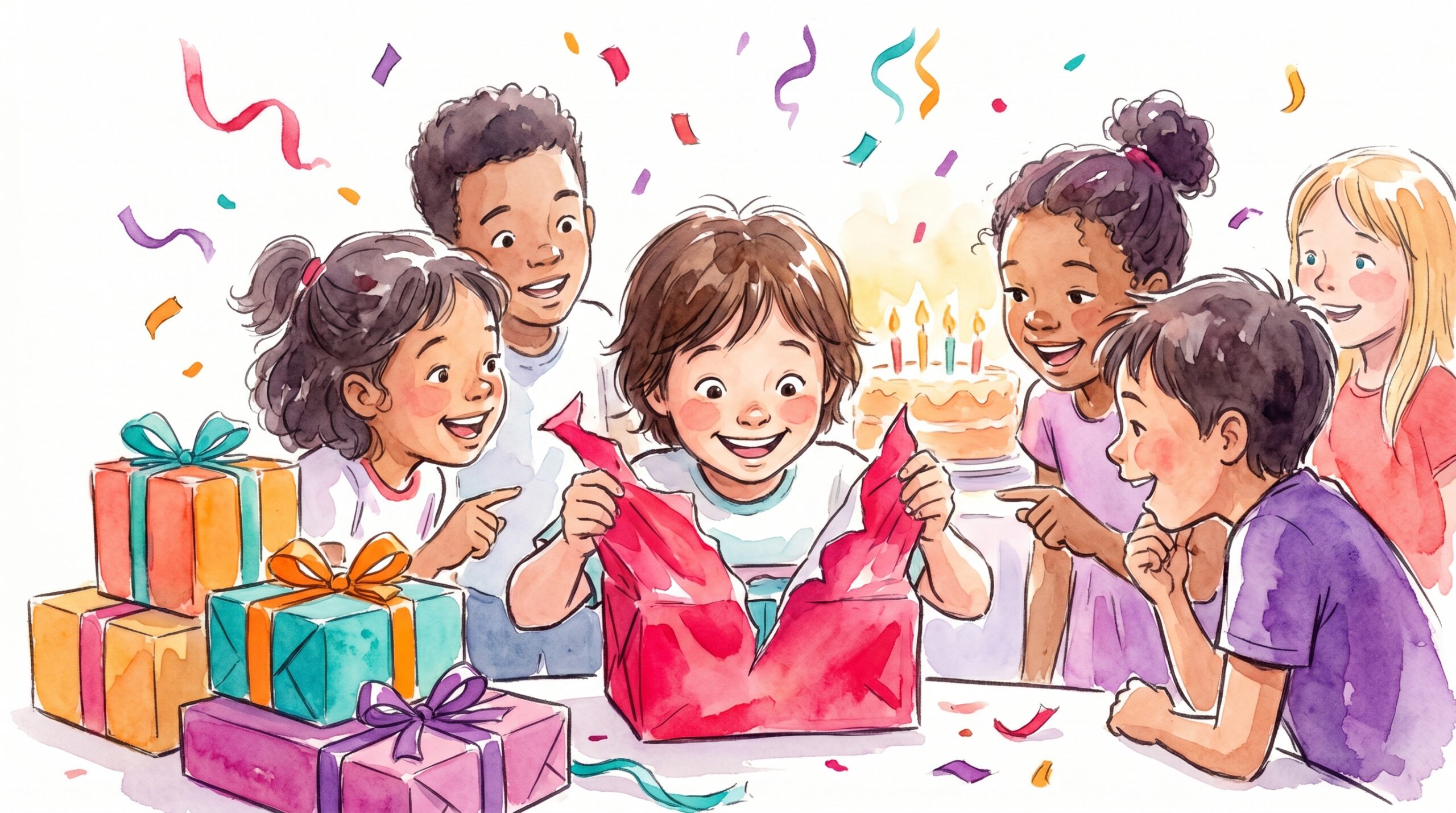
"Feeling happy and celebrated" and "receiving presents" are statistically tied as the top determinants of a great birthday for children, each cited by nearly half of parents globally, according to a Chuck E. Cheese study of 4,961 parents across 26+ countries. The two responses are separated by less than 0.3 percentage points — 48.1% and 47.8% respectively — making them, in effect, equal. The third factor, having a party or fun activity, follows at 42%, trailed by cake and special foods at 37%. What the data makes clear is that birthday success is not defined by any single element but by a convergence of the emotional and the material. A child who feels genuinely celebrated and receives presents has a good birthday; one who gets presents without the emotional recognition does not. Geography produces the most dramatic variation: American parents cite emotional celebration at 56% while German parents cite it at just 21%. And the importance of friends nearly doubles between toddlerhood and the tween years — from 25% at ages 2–3 to 40% at ages 10–12. Here is what the complete data shows.
About This Research
Study Attribution
Chuck E. Cheese Birthday Celebration Study, 2025. n=4,961 parents of children ages 2–12, surveyed online across 26+ countries spanning North America, Latin America, Europe, the Middle East, and Asia-Pacific. Survey question: "Thinking about your child's birthday as a whole — not just the party — what THREE most determine whether your child has a great day?" Respondents selected up to three factors from a list of twelve. Sample was weighted. Results reflect parent-reported perceptions. Press inquiries: [email protected].
Chuck E. Cheese commissioned this research as part of an ongoing effort to understand what actually drives birthday satisfaction for children and families — not assumptions, but data. The study covers a broad age range (2–12), a wide geographic footprint (26+ countries), and a substantial sample (4,961 parents), making it one of the larger published studies on birthday preference specifically directed at parents of young children.
One methodological note deserves upfront acknowledgment: parents are proxy reporters. They are describing what they believe their children want, not what their children directly reported. The study cannot rule out parental projection — a parent from a present-centric culture may overweight gifts; a parent who values emotional expression may overweight the "feeling celebrated" dimension. Results should be read as parental perception of birthday priorities, which is itself a meaningful finding but is not equivalent to asking children directly.
What the Data Shows: A Statistical Tie at the Top
The most important number in this dataset is not a single percentage — it is a non-difference. "Feeling happy and celebrated" was selected by 48.1% of parents globally. "Receiving presents" was selected by 47.8%. The gap between them is 0.3 percentage points, which falls well within sampling error. These two factors are, statistically, indistinguishable as birthday determinants at the global level.
This result directly challenges a common assumption: that gifts are the primary currency of birthday happiness for children. At the aggregate level, that is not what the data shows. Emotional recognition — the child feeling seen, valued, and genuinely celebrated — ranks co-equal with material gifts. Parents who plan their child's birthday around only one of these two dimensions are likely under-delivering on the other.
Source: Chuck E. Cheese Birthday Celebration Study, 2025. n=4,961 parents globally. Respondents selected up to three options.
| Rank | What Determines a Great Birthday | Global % (n=4,961) | Distribution |
|---|---|---|---|
| 1 | Feeling happy and celebrated | 48.1% | |
| 2 | Receiving presents | 47.8% | |
| 3 | Having a party or fun activity | 42.4% | |
| 4 | Enjoying cake or other special foods | 36.9% | |
| 5 | Spending time with friends | 30.5% | |
| 6 | Spending meaningful time with close family | 24.6% | |
| 7 | Taking photos or creating memories | 19.0% | |
| 8 | Being the center of attention | 18.4% | |
| 9 | Spending time with extended family or community | 13.7% | |
| 10 | Getting new privileges or feeling more grown up | 8.6% | |
| 11 | Following family traditions | 6.3% | |
| 12 | Honoring cultural or religious traditions | 3.7% |
The field clusters into three tiers. The top tier — feeling happy, receiving presents, having a party — sits at 42–48% and represents what parents consider the core of birthday success. The second tier — cake, friends, and family time — sits at 25–37% and represents the supporting elements. Everything below that accounts for a small share of citations individually, though they are not unimportant — they matter substantially in specific markets, specific age groups, and specific family cultures.
The distribution also reveals what birthday success is not primarily about. Honoring cultural or religious traditions (4%), following family traditions (6%), and getting new privileges (9%) occupy the bottom of the ranking globally. This doesn't mean these things don't happen at birthdays — it means parents don't cite them as the primary drivers of whether their child had a great day. Birthday satisfaction, in this data, is overwhelmingly personal, experiential, and relational rather than ceremonial or symbolic.
Also notable: "Taking photos or creating memories" (19%) and "being the center of attention" (18%) are nearly statistically tied — two distinct motivations that nearly the same share of parents consider primary. The photo-memory dimension peaks in several MENA and LATAM markets, suggesting its cultural weight varies considerably outside the global average.
The top three factors together — feeling celebrated, receiving presents, and having a party — were collectively cited by the vast majority of parents. A birthday that delivers all three simultaneously is what the data defines as a comprehensive success.
How Birthday Priorities Change as Kids Get Older
Age is the strongest modifier of birthday preferences in the data. Across the 10-year span from toddlerhood to the tween years, several factors shift dramatically — and one (friends) nearly doubles in importance.
Source: Chuck E. Cheese Birthday Celebration Study, 2025. Age groups reflect the child's age at their most recent birthday party.
| Factor | Ages 2–3 (n=735) | Ages 4–5 (n=1,250) | Ages 6–7 (n=1,215) | Ages 8–9 (n=790) | Ages 10–12 (n=728) |
|---|---|---|---|---|---|
| Feeling happy and celebrated | 52% | 47% | 47% | 49% | 48% |
| Receiving presents | 43% | 49% | 48% | 50% | 49% |
| Having a party or fun activity | 40% | 43% | 43% | 46% | 39% |
| Enjoying cake or special foods | 39% | 41% | 40% | 31% | 32% |
| Spending time with friends | 25% | 27% | 30% | 34% | 40% |
| Meaningful time with close family | 31% | 25% | 21% | 25% | 24% |
The toddler and preschool years (ages 2–5) are characterized by food, family, and emotional warmth. Cake and special foods score highest among the youngest children (39% at ages 2–3, 41% at 4–5), then drop sharply — by ages 8–9 the figure has fallen to 31%, a 10-point decline. Meaningful time with close family peaks at 31% for ages 2–3 — highest of any age band — and falls to 21% by ages 6–7, reflecting a developmental transition from family-centric to peer-centric social lives. These patterns aren't surprising, but their magnitude is: food and family lose 8–10 points of importance over the developmental span; friends gain 15.
The transition between ages 6–7 and 8–9 marks the entry into what the data suggests is the birthday high-expectation zone. "Having a party or fun activity" peaks at ages 8–9 (46%), the highest of any age band, at the same moment that "receiving presents" also peaks (50%). Both critical birthday dimensions converge at their highest values in the same two-year window. Parents of 8–9-year-olds face the most demanding birthday brief: a child who expects both a high-quality experience and a meaningful gift pile — and who is capable of comparing their birthday to those of their peers.
The tween years (ages 10–12) complete the reorientation. Friends rise to 40%, approaching the level of the top factors. "Having a party or fun activity" falls back to 39% — back to toddler-era levels. What tweens want is not a party as a production but a birthday as a social event. The venue matters less; who attends matters more. For parents of 10–12-year-olds, the most effective birthday investment may not be the party format at all — it may be ensuring the right people are present.
One remarkable stability finding cuts across all age groups: "feeling happy and celebrated" moves within a narrow 5-point band (47%–52%) across the entire age range. From age 2 to age 12, every cohort places roughly equal weight on emotional recognition. The birthday's function as an occasion for explicit affirmation — "this day is yours; you are seen and celebrated" — appears to be a developmental constant, present in toddlers and still operative in tweens. Whatever else changes about birthday preferences, the emotional core does not.
How Birthday Priorities Vary by Country
No comparison in this dataset is more stark than Germany versus South Korea. German parents cite "feeling happy and celebrated" at 20.9% — by far the lowest rate of any market surveyed, 27 percentage points below the global average. South Korean parents cite it at 62.1% — the highest in the dataset, 14 points above average. These two countries bracket a global range that reflects deeply different cultural frameworks for what birthday success means.
Source: Chuck E. Cheese Birthday Celebration Study, 2025. Markets with n≥100 included. n shown per market.
| Market | n | Feeling Happy & Celebrated | Receiving Presents | Having Party / Fun Activity |
|---|---|---|---|---|
| Western Markets | ||||
| USA | 1,307 | 56% | 46% | 49% |
| UK | 194 | 49% | 49% | 43% |
| Australia | 213 | 47% | 43% | 43% |
| Germany | 176 | 21% | 54% | 48% |
| Latin America | ||||
| Mexico | 189 | 33% | 58% | 32% |
| Colombia | 115 | 30% | 57% | 42% |
| Honduras | 110 | 35% | 59% | 28% |
| Guatemala | 108 | 36% | 58% | 34% |
| Chile | 156 | 31% | 49% | 39% |
| Dominican Republic | 103 | 34% | 49% | 21% |
| Puerto Rico | 103 | 32% | 34% | 22% |
| Trinidad | 104 | 36% | 22% | 24% |
| Middle East & Turkey | ||||
| Saudi Arabia | 185 | 37% | 60% | 33% |
| Egypt | 105 | 55% | 53% | 28% |
| UAE | 195 | 45% | 54% | 34% |
| Kuwait | 177 | 37% | 35% | 41% |
| Qatar | 150 | 29% | 37% | 30% |
| Asia-Pacific | ||||
| South Korea | 124 | 62% | 50% | 33% |
| Taiwan | 182 | 59% | 59% | 18% |
| Malaysia | 104 | 59% | 59% | 30% |
| Thailand | 109 | 53% | 59% | 32% |
| Singapore | 109 | 52% | 40% | 43% |
| India | 109 | 46% | 34% | 41% |
| Global Average | 4,961 | 48% | 48% | 42% |
The United States, at 56%, leads the major Western markets on emotional celebration and sits 8 points above the global average. The UK (49%) and Australia (47%) track near-global norms; Germany (21%) is a profound outlier within its own region. What explains Germany's position is beyond the scope of this data to confirm, but the pattern is consistent with broader cultural tendencies toward reserved emotional expression and gift-centered celebration visible in other European survey research.
Latin American markets as a group show a decisive reordering of priorities. The LATAM regional average for "feeling happy and celebrated" is just 33% — 15 points below global — while "receiving presents" rises to 55%. This isn't a small cultural inflection; it's a fundamental restructuring of what birthday success means. Mexico (58%), Honduras (59%), Guatemala (58%), and Colombia (57%) all place presents well above the emotional dimension. Chile (49% presents) occupies middle ground, and Puerto Rico (34% presents) is the partial exception — its profile more closely resembles Caribbean patterns than mainland LATAM.
Trinidad is the single most extreme market in the presents column: only 22% of Trinidadian parents cite presents as a top birthday determinant — the lowest in the dataset by a wide margin, including lower than the global average by 26 points. The Caribbean as a regional cluster (26% presents, 30% happy) scores low across multiple dimensions, with higher-than-average orientation toward extended family and community involvement.
Within MENA, Egypt (55% happy) stands out sharply from its regional peers (Saudi Arabia 37%, Kuwait 37%, Qatar 29%), aligning more closely with Western emotional-recognition norms. Saudi Arabia leads the dataset on "receiving presents" at 60%, tied only with a few other high-present markets.
East Asian markets produce the most internally balanced profiles. Taiwan and Malaysia show the globally unique pattern of both dimensions scoring equally high — 59% for both "feeling happy" and "receiving presents" simultaneously. South Korea at 62% "feeling happy" is the dataset's high-water mark on the emotional-recognition dimension while still showing 50% on presents. These are markets that appear to demand full-spectrum birthday delivery: emotional, material, and ceremonial.
One dimension where geographic variation is relatively contained: "having a party or fun activity" ranges from 18% (Taiwan) to 49% (USA, Germany), but most major markets with strong samples cluster in the 28–49% range. The structured party-as-event concept does not show a strong Western/non-Western divide the way emotional recognition does. Markets as culturally distinct as Germany (48%) and India (41%) converge on the party-activity dimension even while diverging sharply on everything else.
The global range for "feeling happy and celebrated" spans from 21% (Germany) to 62% (South Korea) — a 41-point spread. No other birthday factor produces as wide a cross-national variance in this data.
What Predicts Birthday Success: Key Segment Analysis
How Planning Horizon Shapes Birthday Priorities
One of the strongest behavioral predictors in the dataset is how far in advance parents plan the birthday. Among families who planned last-minute (less than one week out), only 39% cited "feeling happy and celebrated" as a top factor — 9 points below the global average. Among families who planned more than a month ahead, that figure climbs to 51%. The gradient is monotonic and consistent across every planning window.
Source: Chuck E. Cheese Birthday Celebration Study, 2025. Planning windows are mutually exclusive. Total n=4,961.
| Factor | Less Than a Week (n=539) | 1–2 Weeks (n=1,537) | 3–4 Weeks (n=1,830) | 1+ Month (n=1,055) |
|---|---|---|---|---|
| Feeling happy and celebrated | 39% | 46% | 49% | 51% |
| Receiving presents | 49% | 48% | 49% | 45% |
| Having a party or fun activity | 36% | 36% | 45% | 45% |
| Spending time with friends | 25% | 27% | 31% | 34% |
| Enjoying cake or special foods | 44% | 38% | 37% | 35% |
The planning-horizon data contains two distinct patterns running in opposite directions. The emotional and social dimensions — "feeling happy and celebrated" and "spending time with friends" — both increase steadily as planning advances. The food dimension ("enjoying cake or special foods") moves in the opposite direction, peaking at 44% among last-minute planners and falling to 35% among the earliest planners. One plausible interpretation: cake is the one birthday element that doesn't require planning. It is reliably present regardless of how much preparation went into the day. Families who haven't organized much else fall back on the fundamentals; families who have invested in advance planning distribute their attention across more demanding dimensions.
"Having a party or fun activity" shows a step change rather than a gradient: last-minute and 1–2-week planners both sit at 36%, while 3–4-week and 1-month-plus planners jump to 45%. The implication is that meaningful party experiences — the kind that constitute a memorable activity rather than a gathering — require at least three weeks to organize. Anything planned in under two weeks has roughly the same activity profile as an unplanned birthday.
Presents are the exception to every planning pattern: they score a consistent 45–49% regardless of how much advance preparation went into the birthday. Gift-giving expectations are not modifiable by planning behavior. They are a structural constant.
How Party Venue Type Relates to Birthday Success Factors
Where the last party was held correlates meaningfully with which birthday factors parents prioritize. Home parties over-index on presents; experience venues over-index on the party-activity dimension. The divergence is consistent across every venue type examined.
Source: Chuck E. Cheese Birthday Celebration Study, 2025. Venue segments reflect where the child's most recent birthday party was held.
| Factor | Home (n=2,225) | FEC (n=742) | Trampoline Park (n=623) | Restaurant (n=383) | Outdoor Park (n=394) | Theme Park (n=180) |
|---|---|---|---|---|---|---|
| Feeling happy and celebrated | 48% | 49% | 51% | 33% | 53% | 47% |
| Receiving presents | 52% | 42% | 46% | 48% | 48% | 41% |
| Having a party or fun activity | 39% | 46% | 47% | 40% | 44% | 45% |
| Enjoying cake or special foods | 41% | 35% | 33% | 31% | 32% | 43% |
Home party families over-index on "receiving presents" by 5 points (52% vs. 48% overall) and under-index on "having a party or fun activity" by 3 points (39% vs. 42%). FEC and trampoline park party families show the inverse: presents fall to 42–46%, while the party-activity dimension rises to 46–47%. These two venue philosophies are measuring birthday success along different primary axes — one material, one experiential.
The restaurant birthday finding is the most striking in the venue data. Families whose last party was at a restaurant report "feeling happy and celebrated" at just 33% — 15 points below the global average, and the lowest of any venue type in the dataset. Restaurant parties appear to underperform significantly on the emotional-recognition dimension that is the tied #1 factor globally. This may reflect the format: restaurant birthdays are often quieter, less structured, and less visually differentiated from an ordinary dinner. Whatever the mechanism, the data suggests restaurant venues deliver a consistently different — and by the emotional metric, lower — birthday experience.
Home parties also over-index on cake and special foods (41%), consistent with a home environment where food preparation is central to the celebration and where the experience is food-and-gift-organized rather than activity-organized. Theme parks also over-index on cake (43%), which is somewhat unexpected but may reflect that theme park parties include formal dining packages that make food more prominent than at other venue types.
Planning a birthday?
The data shows ages 8–9 are the peak birthday-expectation window, where both "having a party/fun activity" (46%) and "receiving presents" (50%) simultaneously top their age-group highs. Chuck E. Cheese is purpose-built for exactly this age window — structured entertainment, dedicated party spaces, and celebration logistics handled so parents can focus on the moments that matter.
See birthday party packages →
Parent Gender and Birthday Priority Framing
Mothers and fathers frame birthday success differently, and the gap is large enough to be meaningful. All mothers cite "feeling happy and celebrated" at 51% versus 43% for all fathers — an 8-point difference. This gap is consistent across child gender: mothers of boys (50%) and mothers of girls (52%) both outpace their respective fathers by 8–9 points on the emotional-recognition dimension. On "receiving presents," the gender gap is small and reversed — 47% for all mothers, 48% for all fathers.
This finding suggests that in a two-parent household, the parents are often not optimizing for the same birthday outcome. Mothers are more likely to define birthday success through the lens of emotional recognition; fathers are more evenly distributed between emotional and material dimensions. For planning purposes, this complementarity can be constructive — but it can also be a source of friction if the two parents hold genuinely different definitions of what constitutes a great birthday.
Child gender, by contrast, shows no meaningful variation. Boys and girls are within 2 points of each other on every top-five response option. Birthday preferences, in this data, are not gendered at the child level. The gender effect operates at the parent-reporter level, not the child level.
How CEC Familiarity Relates to Birthday Success Factors
The CEC Segment cut — which groups parents by their level of familiarity and experience with Chuck E. Cheese — reveals a consistent pattern: families with direct experience hosting a party at an experience venue prioritize the party-activity dimension more highly and the presents dimension less so. Among parents who have hosted a party at Chuck E. Cheese, "having a party or fun activity" scores 8 percentage points higher than among parents entirely unaware of the brand.
Source: Chuck E. Cheese Birthday Celebration Study, 2025. CEC Segment reflects brand familiarity and experience tiers.
| Factor | Unaware | Aware, No Visit | Visited, No Party | Hosted Other Party | Hosted CEC Party | Δ (CEC vs. Unaware) |
|---|---|---|---|---|---|---|
| Feeling happy and celebrated | 47% | 48% | 49% | 48% | 50% | +3pts |
| Receiving presents | 51% | 49% | 48% | 46% | 43% | −8pts |
| Having a party or fun activity | 38% | 40% | 43% | 45% | 46% | +8pts |
| Enjoying cake or special foods | 38% | 37% | 36% | 37% | 35% | −3pts |
| Spending time with friends | 28% | 30% | 31% | 32% | 33% | +5pts |
The gradient across the five tiers is monotonic for two of the top factors. "Having a party or fun activity" rises with each step of CEC familiarity, from 38% among parents unaware of the brand to 46% among those who have hosted a party there — an 8-point arc that tracks directly with experience-venue exposure. "Receiving presents" moves in the opposite direction, declining from 51% among unaware parents to 43% among CEC-party hosts. This mirrors the venue-type pattern from Table 4: parents who have direct experience with organized experience-venue parties place greater weight on the experiential dimension and less on the material one.
The "feeling happy and celebrated" dimension shows a smaller but consistent upward movement (+3 points from Unaware to Hosted CEC Party), suggesting that experience-venue parties modestly strengthen emotional-recognition outcomes in parental perception. The effect is not dramatic, but it is directionally consistent.
Drilling Deeper: Where the Effects Compound
Three findings emerge from the interaction of segments that are strong enough to state as standalone, citable conclusions.
Compound Finding 1: Planning and emotional stakes move together. Among families planning more than one month in advance, 51% cite "feeling happy and celebrated" — 12 points higher than last-minute planners (39%). Simultaneously, the 1-month-plus group rates "spending time with friends" 9 points higher (34% vs. 25%) and prioritizes "having a party or fun activity" 9 points higher (45% vs. 36%). Families who invest in advance planning appear to be systematically optimizing for both the social and the emotional dimensions of birthday success. Last-minute birthdays, by contrast, converge on the residual: cake (44%) and presents (49%) — things that happen without planning.
Compound Finding 2: Experience venues and home parties are trading off presents for activity. Home parties cite "receiving presents" at 52% and "having a party or fun activity" at 39%. FEC parties cite presents at 42% and party-activity at 46%. The 10-point presents gap and the 7-point activity gap run in precisely opposite directions. These aren't random deviations — they are coherent profiles. Parents who choose experience venues are, as a group, defining birthday success differently than parents who choose home parties. The venue choice reflects and reinforces a birthday philosophy.
Compound Finding 3: When the party fails, presents loom larger. Parents who said they "loved" their last party reported "receiving presents" at 50%. Parents who said they "didn't like" the party reported it at 53% — 3 points higher. Simultaneously, "having a party or fun activity" drops 8 points among the didn't-like group (35%) versus the loved group (44%). When the experiential elements of a birthday fail, the material dimension doesn't compensate — but it does become more salient in retrospect. A bad party isn't redeemed by good gifts; but parents in the didn't-like group appear to assign more weight to gift-giving, possibly because it's the one thing that still went right.
What These Findings Mean for Parents Planning a Birthday
The research converges on a clear practical framework. A great birthday for a child requires two things delivered simultaneously and without substitution: emotional recognition — the feeling that this day belongs to the child, who is loved and seen — and tangible gift-giving, which functions as a material proof of that love. Neither can replace the other. A birthday heavy on presents but light on genuine celebration will underperform on the #1 factor; a celebration heavy on emotional warmth but without presents will underperform on the #2 factor. The data suggests children want both, in approximately equal measure.
Four additional implications follow from the segment analysis.
First, the party-or-activity dimension matters most between ages 6 and 9 — and it peaks at ages 8–9, exactly when presents also peak. Parents in this window face the highest birthday expectations of any age band: a child who wants a real party, real gifts, and to feel genuinely celebrated. Home-party formats may under-deliver on the activity dimension at this age, since home parties show the lowest scores on "having a party or fun activity" (39%) of any venue type. If the party-activity element is a priority — and at ages 8–9, it is — the venue choice matters.
Second, advance planning is strongly associated with better birthday outcomes on the dimensions parents cite as most important. The 12-point gap between early-planner and last-minute-planner families on "feeling happy and celebrated" is one of the strongest behavioral predictors in the dataset. Whatever the causal direction — whether planning ahead causes better outcomes or whether families who prioritize birthdays plan earlier — the correlation is clear. The data argues against leaving birthday planning to the last week.
Third, friends become a primary birthday element much earlier than many parents may assume. By ages 6–7, 30% of parents already cite friend-time as a top factor. By 10–12, it rises to 40%. Social coordination — inviting the right friends, ensuring they can attend, building the party around social interaction rather than just structured entertainment — becomes increasingly central to birthday success throughout elementary school. The families who prioritize friend-time also tend to plan earliest (34% at 1+ month vs. 25% at less than a week), which is itself a signal about what planning-intensive birthday success looks like.
Fourth, the cross-cultural variation in this data counsels against a one-size-fits-all birthday philosophy. A Mexican family where presents are cited by 58% of parents is operating with a materially different definition of birthday success than an American family (46% presents). A South Korean family where 62% cite emotional celebration has a different priority architecture than a German family at 21%. Families with multicultural backgrounds, or those celebrating birthdays across national contexts, may find that their expectations are literally located in different parts of the global distribution.
Study Methodology and Limitations
Full Methodology Disclosure
Chuck E. Cheese Birthday Celebration Study, 2025. n=4,961 parents of children ages 2–12. Online survey administered across 26+ countries. Weighted sample. Survey question: respondents selected up to three factors from a list of twelve determining "what most determines whether your child has a great birthday." Results reflect parent-reported perceptions of child birthday preferences; children were not surveyed directly. As proxy reporters, parents may project personal, cultural, or aspirational values onto their assessments. Results reflect stated preferences, not observed behavior — a parent who selects "feeling happy and celebrated" may or may not have successfully delivered that outcome. Markets with n below 100 were excluded from market-level analysis (Vietnam n=86, Japan n=88, Suriname n=76, Panama n=90, El Salvador n=99). Turkey (n=95) was included in regional aggregates but approached cautiously at the individual-market level. Regional aggregates reflect weighted averages of included markets. For press or research inquiries, contact [email protected].
Frequently Asked Questions About What Makes a Great Birthday for a Kid
What do kids want most on their birthday?
According to a Chuck E. Cheese study of 4,961 parents, children want two things almost equally: to feel genuinely happy and celebrated (cited by 48.1% of parents as a top factor) and to receive presents (47.8%). These two factors are statistically tied — separated by less than 0.3 percentage points — making them co-equal at the top of the birthday success hierarchy. Having a party or fun activity (42%) and enjoying cake or special foods (37%) follow as the third and fourth most common determinants.
Does what kids want for their birthday change as they get older?
Significantly. The most dramatic shift is in the importance of friends, which nearly doubles from 25% at ages 2–3 to 40% at ages 10–12 — the largest age-related change in the data. Cake and special foods peak in the preschool years (41% at ages 4–5) and decline steadily to 31–32% in middle childhood. Close family time peaks at 31% for toddlers and falls to 21% by ages 6–7. Conversely, "feeling happy and celebrated" is the most stable element across all ages, staying within a narrow 47–52% band throughout childhood. The core emotional need doesn't change; the social context around it does.
Are birthday gifts really the most important thing to kids?
Not exclusively, and not universally. At the global level, gifts and emotional recognition are statistically tied at ~48% each. But geography matters considerably: in LATAM markets, presents lead at 55% while emotional celebration scores 33%; in Western markets, the emotional dimension (56%) leads over presents (46%). Among families whose last party was at an experience venue like an FEC, presents score 8–10 points lower than among home-party families, suggesting that a high-quality party experience reduces the salience of gifts. The short answer: presents matter everywhere, but they don't dominate everywhere — and several factors mediate how much.
Does birthday planning time in advance affect how good the birthday is?
The data shows a consistent 12-point gap in "feeling happy and celebrated" between families who planned more than a month ahead (51%) and those who planned less than a week out (39%). Advance planning also correlates with higher friend-time priority (34% vs. 25%) and higher party-activity priority (45% vs. 36%). The causal direction can't be confirmed from this data — families who value emotional celebration may simply plan earlier. But the association is strong: early-planned birthdays and the priorities associated with emotional success move together consistently. Gifts are the one exception — they score flat across all planning windows.
Do boys and girls want different things on their birthday?
No — not in any meaningful way, according to this data. Boys and girls are within 2 percentage points of each other on every top-five birthday factor. Where gender does show a gap is at the parent-reporter level: mothers cite "feeling happy and celebrated" at 51% versus 43% for fathers — an 8-point difference that holds consistently across both sons and daughters. So the gender effect in this study operates through parental perception, not child preference. Mothers are more likely to define birthday success through emotional recognition; fathers show a more even split between emotional and material dimensions.
Which country places the most importance on kids feeling celebrated on their birthday?
South Korea leads the study at 62.1%, followed by Taiwan and Malaysia (both 59%), and Egypt (55%) — a MENA outlier that stands apart from its regional peers. Among major Western markets, the USA scores highest at 56%. Germany is the most striking outlier in the opposite direction, at just 20.9% — the lowest in the dataset and 27 points below the global average of 48%. German parents instead weight presents (54%) and having a party or fun activity (48%) far more heavily than emotional recognition. East Asian markets collectively average 58% on the "feeling celebrated" dimension, making them the highest-scoring regional grouping globally.
Is a home birthday party as good as a venue party for kids?
Different, rather than better or worse — depending on what you're optimizing for. Home parties over-index on presents (52% vs. 48% overall) and cake (41%), but under-index on "having a party or fun activity" (39% vs. 42%). FEC and trampoline park parties flip this: lower presents (42–46%), higher party-activity (46–47%). The one venue type that underperforms across the board on birthday satisfaction is restaurant parties, which show "feeling happy and celebrated" at just 33% — 15 points below the global average and the lowest of any venue type. If the party-activity dimension is a priority — which it is especially at ages 8–9 — the data suggests home parties may not deliver as strongly on that element as experience venues do.
How was the Chuck E. Cheese birthday research conducted?
The Chuck E. Cheese Birthday Celebration Study, 2025, surveyed 4,961 parents of children ages 2–12 online across 26+ countries in North America, Latin America, Europe, the Middle East, and Asia-Pacific. Parents were asked to select up to three factors from a list of twelve that most determine whether their child has a great birthday — considering the full day, not just the party. The sample was weighted. Because parents are proxy reporters — describing what they believe their children want — findings represent parental perception of birthday priorities rather than direct child responses. Markets with fewer than 100 respondents were excluded from country-level analysis.
What is the most surprising finding in the birthday research?
Germany. In a study where the global average for "feeling happy and celebrated" is 48%, German parents cite it at just 20.9% — 27 points below average and the lowest of any country surveyed. Germany instead heavily weights "receiving presents" (54%) and "having a party or fun activity" (48%). This isn't a slight deviation; it's a categorical reordering of birthday priorities. Within the same study, South Korea sits at 62% on the emotional-recognition dimension. No other cross-national comparison in the data produces a variance as wide as the 41-point spread between these two markets on a single factor. Both responses are correct within their respective cultural contexts — which is the broader point: birthday success is not a universal concept.
Does this research mean parents should focus more on emotions than gifts?
The data doesn't support a hierarchy between them — it argues for both. Globally, "feeling happy and celebrated" and "receiving presents" are within 0.3 percentage points of each other. A birthday that invests heavily in one and neglects the other is likely underperforming on whichever it neglects. The more useful framing from this research: what varies by age, culture, and planning behavior is not whether both elements matter, but how the balance between them shifts. Among tween-age kids, friends start to rival both; among toddlers, family and cake are more prominent. But at no age and in no major market does either the emotional or the material dimension disappear from the top-tier birthday priorities.
Releated Content
Do Families Limit the Number of Kids at a Birthday Party?
Most parents don't cap the birthday guest list: 58% let the child invite freely, 42% set a limit. Among limiters, keeping it…
June 2026
What Would Make Your Child’s Next Birthday Even Better Than the Last? | Chuck E. Cheese
Parents say more games (34%) and a bigger venue (28%) would have improved their child's last birthday. Better food and cake ranked…
May 2026
What Is the Highlight of a Child’s Birthday Party?
Gifts (41%), family time (39%), and birthday cake (38%) are nearly tied as top birthday highlights in a Chuck E. Cheese study…
May 2026
Plan a Birthday That Matches What They Actually Want
The data is clear: kids need to feel genuinely celebrated and receive presents — and from ages 6–9, a real party experience matters as much as either. Chuck E. Cheese is purpose-built for exactly that combination: dedicated party spaces, structured entertainment, food packages, and a celebration format that takes the logistics off your plate so you can focus on the moments that matter.