Birthday Research Center · Study
Birthday Food Traditions: What Families Actually Serve
Survey of 4,995 parents · The global birthday food hierarchy
What foods do families actually serve at kids' birthday parties?
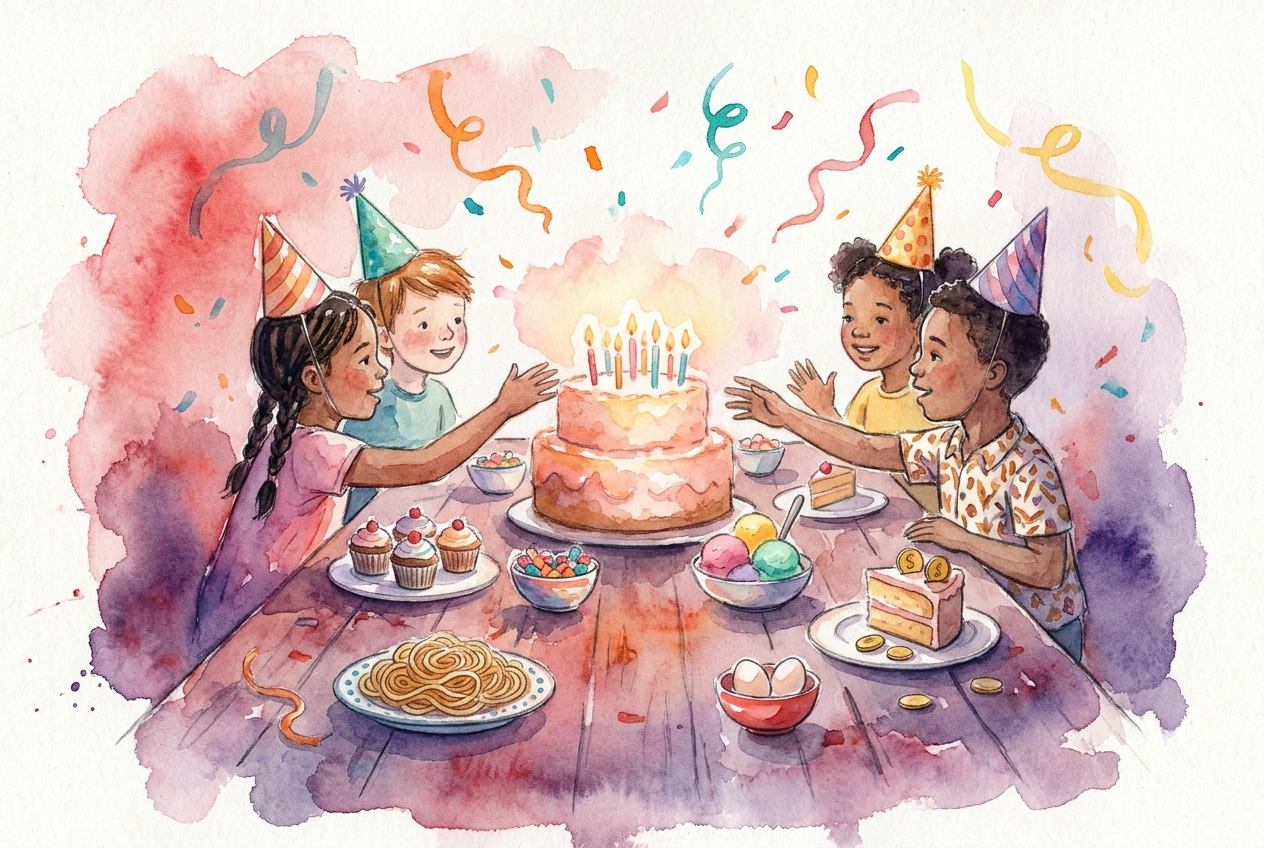
Cake is the near-universal birthday food — served by 79% of families worldwide — followed by ice cream (55%), candy or sweets for guests (50%), and cupcakes (38%). Almost everything else is regional.
Cake shows up at nearly every party in every market studied, making it the single most consistent birthday tradition on earth. Ice cream is next, but with a much wider regional spread — 65% of American families serve it, compared to just 29% in East Asia.
Beyond those two, birthday food splits sharply along cultural lines: cupcakes and smash cakes dominate in Western markets, while longevity noodles, red eggs, and rice yogurt rituals define birthday food in East and South Asia. The shape of the celebration is global; the texture is local.
This study breaks down what families serve at kids' birthdays by region, by age of the child, and by what actually distinguishes a great party from a mediocre one (which, as the data shows, has very little to do with the food).
What's the global birthday food hierarchy?
Across 4,995 parents in 25+ countries, the ranking of birthday foods is remarkably stable at the top and wildly variable below it.
| Food tradition | % of families globally |
|---|---|
| Cake | 79% |
| Ice cream | 55% |
| Candy, chocolates, or sweets for guests | 50% |
| Cupcakes | 38% |
| Smash cake (for younger kids) | 13% |
| Fruit or sweet offerings at temples | 11% |
| Coins hidden in cakes | 6% |
| Fairy bread | 5% |
| Longevity noodles | 5% |
| Special porridge or soups | 5% |
| Rice yogurt on forehead | 5% |
| Seaweed soup and rice cakes | 4% |
| Red eggs | 3% |
| Brigadeiros | 2% |
The top four account for the vast majority of what families actually serve. Everything else is a regional or religious tradition — meaningful to the families who keep them, but not global.
Do birthday foods change as kids get older?
Food traditions are the most stable part of birthday celebrations across age groups. The big four — cake, ice cream, sweets, and cupcakes — barely shift from preschoolers to tweens.
| Food tradition | Ages 2–5 | Ages 6–9 | Ages 10–12 |
|---|---|---|---|
| Cake | 78% | 80% | 80% |
| Ice cream | 52% | 57% | 57% |
| Candy/sweets for guests | 48% | 53% | 46% |
| Cupcakes | 39% | 39% | 35% |
| Smash cake | 15% | 11% | 11% |
Two patterns stand out. First, smash cakes are almost entirely a young-child tradition — 15% at ages 2–5, dropping to 11% by age 6. This tracks with the first-birthday photo ritual that has become standard in American and Latin American households. Second, cupcakes soften slightly by age 10 as tweens tend toward a single themed cake or dessert table over individual cupcakes. The headline staples — cake, ice cream, sweets — barely move at all across the 2–12 age range.
What do American families actually serve at birthday parties?
American families lean harder into the Western birthday food canon than almost any other market.
- Cake: 82% (slightly above the global 79%)
- Ice cream: 65% — the largest U.S.-over-global gap at 10 points
- Cupcakes: 42% (vs. 38% global)
- Candy and sweets for guests: 42% (below the global 50%)
The ice cream finding is the most striking. American families are nearly twice as likely as East Asian families (29%) and significantly more likely than Middle Eastern families (37%) to pair cake with ice cream. It's a uniquely American expectation.
Where Americans under-index is in the "sweets for guests" category. Only 42% of U.S. families send home goody bags or treat spreads — compared to 67% in LATAM and 78% in India. The American birthday party tends to concentrate the food experience in the moment of the party itself, while many other cultures extend it into what guests take home.
How do birthday foods vary around the world?
This is where the data gets genuinely interesting. Outside the top four globals, nearly every birthday food is regional.
| Food tradition | USA | LATAM | MENA + Turkey | East Asia | Southeast Asia | India |
|---|---|---|---|---|---|---|
| Cake | 82% | 82% | 66% | 87% | 84% | 91% |
| Ice cream | 65% | 41% | 37% | 29% | 51% | 73% |
| Candy/sweets for guests | 42% | 67% | 58% | 27% | 52% | 78% |
| Cupcakes | 42% | 27% | 40% | 11% | 34% | 37% |
| Longevity noodles | 3% | 2% | 12% | 6% | 9% | 22% |
| Seaweed soup & rice cakes | 2% | 2% | 8% | 27% | 7% | 7% |
| Red eggs | 1% | 2% | 7% | 3% | 11% | 1% |
| Rice yogurt on forehead | 3% | 4% | 10% | 1% | 5% | 20% |
| Brigadeiros | 1% | 2% | 5% | 1% | 4% | 1% |
India is the world's ice cream capital at 73% — even higher than the U.S. — and also the most ritual-dense market, with 54% of families making temple food offerings and 20% performing the rice yogurt blessing.
East Asia is the quiet outlier. Families serve cake at higher rates than anywhere else (87%) but skip almost every other Western tradition. Instead, 27% of East Asian families serve seaweed soup and rice cakes — a Korean tradition tied to a mother's postpartum meal that's eaten annually to honor her.
MENA + Turkey shows the lowest cake rate globally (66%) but the highest rate of coins hidden in cakes (13%) and special porridge or soups (9%) — food rituals tied to blessing and prosperity rather than to the cake-and-candle archetype.
What actually makes birthday food "work" at a party?
The most counterintuitive finding in this study: when parents rated their last birthday party, food participation was nearly identical between parties rated 5/5 and parties rated 1–3.
- Cake served at 80% of top-rated parties vs. 79% of poorly-rated parties
- Ice cream served at 56% of top-rated vs. 55% of poorly-rated
- Cupcakes served at 43% of top-rated vs. 37% of poorly-rated
The difference between a great birthday party and a mediocre one isn't what food showed up. It's how the food was delivered, who was there, and whether the parents were stressed running the show. The food matters; what doesn't matter is whether you've added one more dessert option.
Where do parents spend their birthday-food energy?
Among parents who reported feeling "socially pressured to celebrate a certain way," cake service was slightly higher (77%) — but the bigger gap shows up in cupcakes (40% pressured vs. 35% no pressure) and smash cakes (15% pressured vs. 10% no pressure). Pressured parents add more cake formats, not different ones.
The pattern is consistent with what shows up elsewhere in our research: the parents who feel pressure tend to over-deliver on the visible elements — what shows up on the table, what the camera captures, what guests will mention later. The parents who feel no pressure tend to simplify. Neither approach correlates with the kid actually having a better time.
What were the full study results?
Distribution of birthday foods served — global sample of 4,995 parents.
| Food tradition | % of families |
|---|---|
| Cake | 79% |
| Ice cream | 55% |
| Candy, chocolates, or sweets for guests | 50% |
| Cupcakes | 38% |
| Smash cake (for younger children) | 13% |
| Fruit or sweet offerings at temples | 11% |
| Coins hidden in cakes | 6% |
| Fairy bread | 5% |
| Longevity noodles | 5% |
| Special porridge or soups | 5% |
| Rice yogurt on forehead | 5% |
| Seaweed soup and rice cakes | 4% |
| Red eggs | 3% |
| Brigadeiros | 2% |
| Oto | 2% |
Frequently asked questions
-
What foods are most commonly served at kids' birthday parties?
Globally, the most common birthday foods are cake (79% of families), ice cream (55%), candy or sweets for guests (50%), and cupcakes (38%). According to this study of nearly 5,000 parents, these four show up at the vast majority of parties worldwide. Other traditions like longevity noodles, red eggs, or temple offerings are specific to certain regions and religions.
-
Do Americans serve different birthday foods than the rest of the world?
Mostly no on cake, distinctly yes on ice cream. American families serve cake at the same rate as most regions (82%), but ice cream is uniquely American: 65% of U.S. families serve it at birthday parties — more than double the East Asian rate of 29% and well above the global average of 55%. Americans also under-index on guest goody bags and sweet trays compared to Latin American or Indian families.
-
At what age do families stop doing smash cakes?
Smash cakes are primarily a young-child tradition. 15% of families with kids ages 2–5 incorporate a smash cake, dropping to 11% by ages 6–9 and 10–12. The tradition is tied to the first-birthday photo ritual that has become standard in American and Latin American households, and most families phase it out after age 5.
-
Why do some cultures hide coins in birthday cakes?
Hiding coins in cakes is a tradition tied to luck, prosperity, and blessing the birthday person for the year ahead. Globally, 6% of families do it, but rates are much higher in MENA + Turkey (13%), the Caribbean (20%), and India (7%). Whoever finds the coin is said to receive good fortune — a tradition that traces back to European and Middle Eastern customs over many centuries.
-
What are longevity noodles, and why are they served at birthdays?
Longevity noodles are long, uncut noodles traditionally served at Chinese birthday celebrations. The length of the noodle symbolizes a long life, and they're not to be cut while eating. Globally 5% of families serve them, but the tradition is strongest in India (22%), MENA + Turkey (12%), and Southeast Asia (9%). They're often served alongside or instead of a Western-style cake.
-
Do I have to serve ice cream at a kids' birthday party?
Ice cream pairs with cake in 55% of birthday parties globally, but it's far from universal. American families expect ice cream at 65%, while East Asian families serve it at just 29%. The decision often comes down to family preference, climate, and venue logistics. Globally, plenty of families have great birthdays with cake but no ice cream.
-
What's the most surprising finding about birthday food?
The most counterintuitive finding is that food participation rates are nearly identical between parents who rated their last party top-tier (5/5) and parents who rated it poorly (1–3/5). What makes a party succeed isn't whether cake or ice cream showed up — it's the execution, the environment, and whether the parents were stressed during the event. Adding more food doesn't fix a stressful party.
-
Why does India serve so much ice cream at birthdays?
India is actually the world's ice cream capital at kids' birthdays — 73% of Indian families serve it, even higher than the U.S. The combination of warm climate and the prevalence of dairy in Indian dessert culture (kulfi, lassi-based sweets, and ice cream itself) makes ice cream a natural birthday staple. India is also the most ritual-dense market overall, with 54% of families making temple food offerings and 20% performing the rice yogurt blessing — the food experience extends well beyond the cake table.
Other studies in this series
-

What Kids Actually Want at Their Birthday Party
Read the study → -
When Kids Start Anticipating Their Birthday
Read the study → -

How Parents View Their Kid's Birthday
Read the study →
See all six studies and the cross-cutting findings at the Birthday Research Center.
Visit the Birthday Research Center →