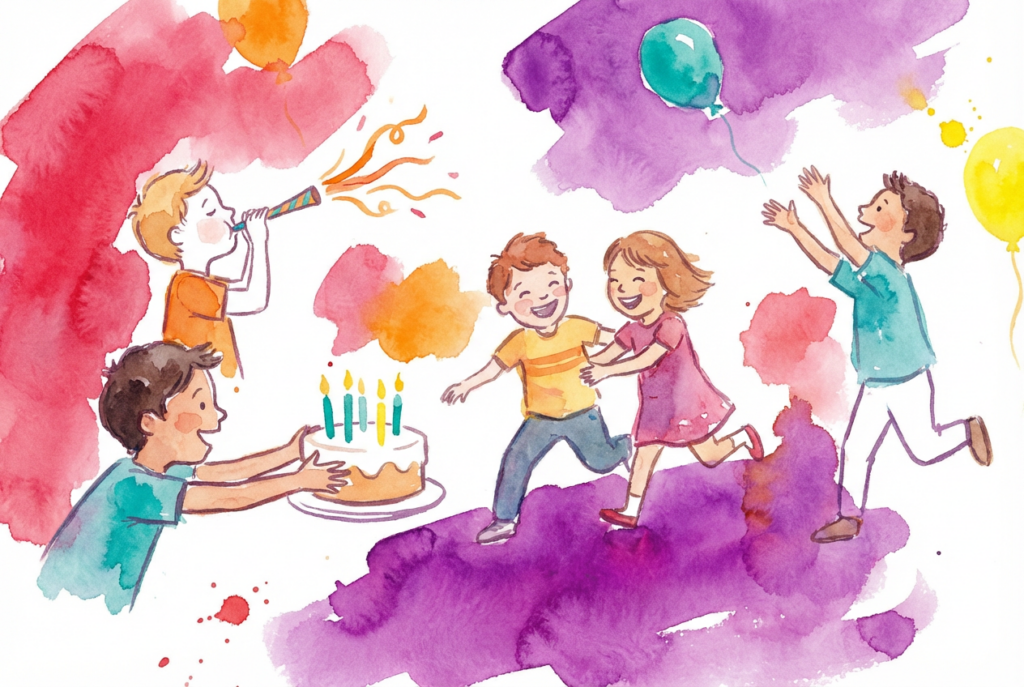
Here’s something that might save you a few hours on Pinterest: only 23% of parents worldwide say a special theme or decorations would make their child’s next birthday better. The number one answer, by a wide margin? More games and activities. One in three parents said so, and it held true across every age group, every country, and every type of family in our study of nearly 5,000 parents.
That gap between what parents spend their energy on and what kids actually want is one of the most consistent findings in our research. And it’s worth paying attention to.
Why “More Fun” Beats “More Fancy” in Every Age Group
Across the board, 34% of parents said more activities would be the biggest upgrade to their child’s next party. Not a better venue. Not better food. Just more things to do.
Among families who’ve celebrated a birthday at Chuck E. Cheese, that number jumps to 42%. These are parents who’ve already figured out that the experience is the party — they’ve solved the location question and now they’re optimizing for maximum fun. They also underindex on themes and decorations (21% vs. 23% overall). It’s not that presentation doesn’t matter to them. It’s that they’ve learned where the real value is.
That insight tracks with our party ratings data: parents who gave their child’s last birthday a perfect score were significantly more likely to have prioritized activities and the social experience over aesthetics. Parents who rated the party poorly? They were more likely to say they wished the food had been better or the party had lasted longer. The best parties aren’t the prettiest ones — they’re the most fun.
What Changes Between Ages 3 and 12
The desire for more activities stays remarkably stable as kids grow, but everything else shifts.
For the youngest kids (ages 2-5), having a favorite character or performer show up is a big deal — 21% of parents flagged this, roughly double the rate of older kids. At that age, a familiar character is the magic.
By ages 6-9, the prime birthday party window, kids start wanting a bigger stage. Nearly 30% of parents in this group said a different or bigger location would be the top improvement. Friend groups are expanding, opinions are getting louder, and the living room feels small.
Then something interesting happens at 10-12: the social dimension takes over. “More friends and family” spikes to 30%, the highest of any age group, and demand for personalized gifts jumps to 22%. These kids are socially aware. Having the right people there — and feeling individually recognized — matters more than where the party happens.
Moms and Dads Don’t Agree on This
One of the more surprising splits in our data is between moms and dads.
Moms of boys are the single most activity-focused segment in the study: 37% said more games and activities would be the top improvement. Moms of girls lean harder into themes and decorations — 26% vs. 21% for moms of boys.
Dads tell a different story entirely. Dads of girls are the most likely of any parent segment to want a bigger or different location (32%), and dads across the board are more likely than moms to say they want longer party time (17-18% vs. 13-14%). Whether that reflects a desire to get more value for the money or just to enjoy the chaos a little longer, we’ll leave to your household to debate.
The Social Factor Most Parents Miss
Here’s a finding worth sitting with. We asked parents to describe their child’s social style, and the answers revealed a meaningful split in what would improve the party.
For kids with large friend groups, parents focus on the experience — more activities, better locations, themes that impress a crowd. But for kids with a smaller circle of friends, 27% of parents said simply inviting more people would be the biggest improvement, compared to 23% for the big-group kids.
For some children, the best birthday upgrade isn’t a better venue or a fancier cake. It’s a fuller room.
Families who’ve considered Chuck E. Cheese for a party seem to understand this instinctively. They were significantly more likely than average to say that inviting more friends and family would make the biggest difference (31% vs. 25% overall). A party venue that makes it easy to say “yes, bring everyone” solves a problem many parents don’t even realize they have.
What Parents Around the World Told Us
Birthday culture varies more than you might expect. In Japan, 58% of parents said better food and cake options would improve the party — nearly four times the global average. In East Asia broadly, only 7% care about a bigger location, compared to 28% globally. Parties there are intimate by design.
Meanwhile, in Guatemala, the desire for a bigger location hits 45% — the highest of any country in our study. And in Puerto Rico, 47% of parents want more activities, the single highest country-level response for that question.
The thread that connects all of it? Regardless of geography or culture, parents everywhere are trying to give their kid a birthday that feels special to that kid. The specifics vary. The motivation doesn’t.
What This Means for Your Child’s Next Party
If you’re planning a birthday and wondering where to put your time and budget, the data points to a clear priority order. Start with activities — make sure there’s plenty to do. Then focus on the guest list, especially as your child gets older. Save the theme and decorations for last. They add polish, but they’re not the foundation.
The families who throw the highest-rated parties in our study aren’t the ones who spent the most on decorations. They’re the ones who made sure the kids never stopped moving, laughing, and playing together.
That’s the real secret to a great birthday party. And it’s a lot simpler than matching the napkins to the tablecloth.