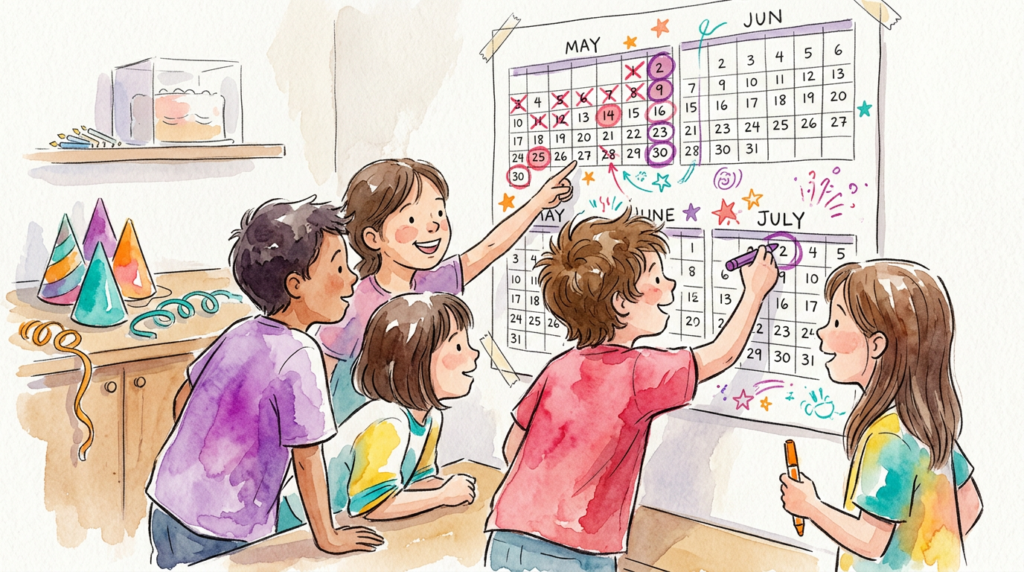
Most kids start anticipating their birthday at least a month in advance — and nearly 1 in 3 are excited about it for several months beforehand.
According to the Chuck E. Cheese Birthday Celebration Study of 5,013 parents globally, 31% say their child started talking about their birthday several months before the date. Another 28% started about a month out. Only 11% waited until just a few days before. Taken together, nearly 7 in 10 kids begin the birthday countdown at least a month in advance.
As one of the country’s largest birthday party destinations, Chuck E. Cheese sees this anticipation firsthand — and it’s one reason early booking is such a common pattern among families planning a celebration.
This research breaks down birthday anticipation by age group, geography, and planning behavior, giving parents and party planners a clearer picture of what to expect — and when to start planning.
How Birthday Anticipation Changes as Kids Get Older
The countdown to a birthday looks very different depending on a child’s age — and the differences are sharper than most parents might expect.
Among the youngest kids (Little Learners, ages 2–5), birthday excitement is distributed fairly evenly. About 19% start talking about their birthday just a few days before, and another 24% start about a month in advance. This age group lives more in the present, and anticipation tends to build quickly when the day gets close rather than stretching far ahead.
Social Players (ages 6–9) show a notable shift toward longer-horizon anticipation. Only 6% start just a few days out — a significant drop from the youngest group — while 33% begin their countdown several months ahead. These kids have a firmer sense of time and a more developed social awareness around birthdays: what the party will look like, who will be invited, where it will be held.
Emerging Independents (ages 10–12) show the longest anticipation windows of any group. More than 36% start months in advance, and over 33% start about a month ahead. For these kids, a birthday is a fully formed social event with expectations, preferences, and often strong opinions about the venue.
| How Far in Advance | Ages 2–5 | Ages 6–9 | Ages 10–12 |
|---|---|---|---|
| Just a few days before | 19% | 6% | 5% |
| A week or two before | 21% | 18% | 16% |
| About a month before | 24% | 30% | 33% |
| Several months before | 27% | 33% | 36% |
| All year long | 9% | 14% | 10% |
Chuck E. Cheese’s sweet spot — kids ages 3–8 — spans the period when birthday anticipation is transitioning from spontaneous excitement to sustained, months-long countdown. That’s the window when planning early pays off most. See birthday parties for toddlers and birthday parties for 5–7 year olds for age-matched package options.
What American Kids’ Birthday Anticipation Looks Like
American kids show a pronounced tendency toward longer anticipation windows compared to some other markets.
In the USA, 32% of parents say their child started building excitement several months in advance — consistent with the global average of 31%. But the most notable finding is at the short end: only 8% of U.S. kids waited until just a few days before, compared to 11% globally. American birthday culture, particularly around structured party planning, appears to drive earlier engagement.
With 30% of American parents saying their child’s excitement begins a month out, venues like Chuck E. Cheese — where party packages can book out weeks in advance, especially on weekends — align naturally with how families actually plan celebrations.
How Birthday Anticipation Varies Around the World
Birthday countdown behavior shows meaningful variation across global markets, reflecting differences in cultural context, family dynamics, and how birthdays are celebrated.
Caribbean markets stand out for compressing anticipation into a much shorter window. Among parents in Caribbean countries, 19% say excitement began just a few days before — nearly double the global average of 11%. Only 9% reported months-long anticipation.
MENA+Turkey markets (Saudi Arabia, Egypt, Kuwait, Qatar, UAE, Turkey) show the opposite pattern: 28% report anticipation beginning a week or two out, and a combined 49% report at least a month of advance excitement — longer sustained anticipation than the global average.
| Market | A Few Days Before | A Month Before | Several Months Before |
|---|---|---|---|
| Global Overall | 11% | 28% | 31% |
| USA | 8% | 27% | 32% |
| Caribbean | 19% | 26% | 13% |
| MENA+Turkey | 11% | 26% | 23% |
| India | 17% | 39% | 23% |
What Birthday Anticipation Tells Us About Party Planning
The data makes one thing clear: by the time a child starts talking about their birthday, the planning window is shorter than it feels. If 31% of kids start months in advance, and parents wait until anticipation peaks to book a venue, they may already be cutting it close.
This is particularly relevant for the 52% of parents who said their last party was planned with more than four weeks of lead time. That group skews heavily toward longer anticipation: 51% of parents who planned more than four weeks out also reported their child’s excitement started months in advance. The excitement and the planning tend to travel together.
Parents who have hosted at Chuck E. Cheese are less likely to be in the last-minute group — consistent with the reality of booking a structured party experience. Check the birthday party FAQ for answers on booking timelines and what’s included.
Planning a birthday party? Chuck E. Cheese takes care of everything — the food, the games, the cake, and the cleanup — so parents can focus on celebrating. See birthday party packages.
Who Decides When to Start Planning — and Who Drives the Excitement
Birthday anticipation is almost always child-driven regardless of who picks the venue. A kid who starts talking about their birthday four months out isn’t waiting for the parent to book something — they’re already building a mental picture of what the day will look like.
For venues like Chuck E. Cheese, where kids ask for the experience by name, the child’s anticipation often narrows the venue decision naturally. Parents can get a head start with printable birthday invitations and Birthday Club membership to make the planning process easier.
Full Study Results: How Far in Advance Kids Anticipate Their Birthday
Source: Chuck E. Cheese Birthday Celebration Study, n=5,013 parents surveyed globally
| How Far in Advance Birthday Excitement Starts | % of Parents |
|---|---|
| Several months before | 31% |
| About a month before | 28% |
| A week or two before | 19% |
| All year long | 11% |
| Just a few days before | 11% |
Frequently Asked Questions
How far in advance do kids typically start looking forward to their birthday?
Does birthday anticipation change as kids get older?
How early should I book a birthday party venue?
Do American kids start anticipating birthdays earlier than kids in other countries?
Is it normal for a young child to not seem excited about their birthday until the last minute?
What’s the best place to have a kids’ birthday party?
Do kids care more about the party itself or just the day?
Do kids who have been to a Chuck E. Cheese party anticipate birthdays differently?
Plan a Birthday They’ll Never Forget
The research is clear: kids start looking forward to their birthday far earlier than most parents realize — often months in advance. Chuck E. Cheese is built around exactly that level of anticipation. With all-inclusive packages, dedicated party hosts, arcade games, pizza, and cake, everything is handled so families can focus on the moment that actually matters. Book early, and the excitement becomes part of the experience — not a source of stress.